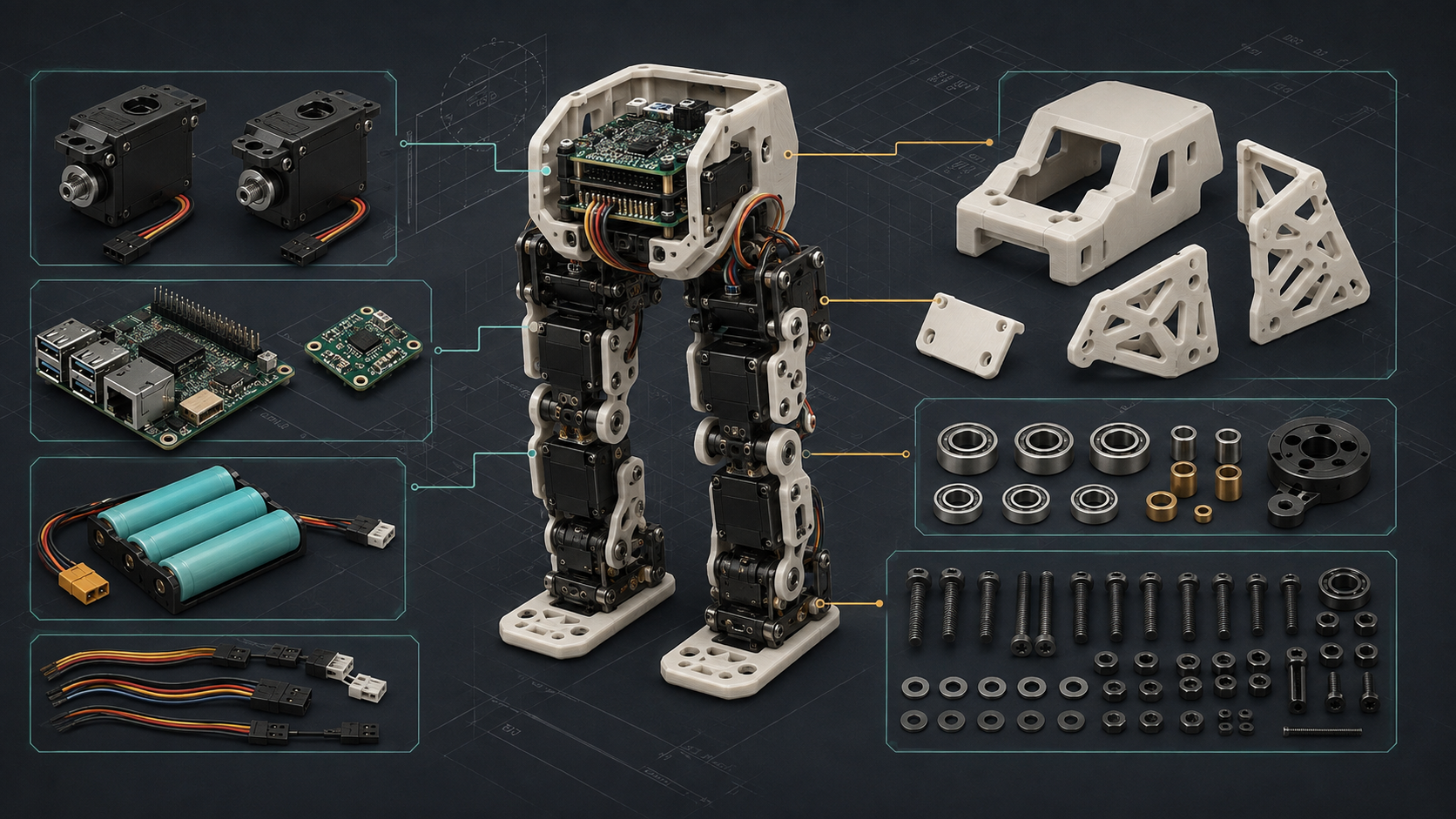
The honest answer is that Open Duck Mini v2 does not have one fixed build price. As checked on September 8, 2026, the project-linked BOM spreadsheet reports €398.10 for the core parts list and €432.34 with the optional expression package. A separate, maintainer-linked Tnkr kit is currently listed at $600. None of those figures is a universal all-in cost: shipping, taxes, tools, printing failures, spare parts, and builder time can change the result substantially.
That distinction matters. “BOM cost” is the sum of planned parts. “Build cost” is what it takes you to reach a working, calibrated robot.
If you are deciding between a finished product and a self-build, start with the MicroDuck vs Open Duck Mini v2 builder’s guide. For the system basics behind the parts list, see what makes a small biped robot work.
Key facts
- The Open Duck Mini v2 repository describes a roughly 42 cm biped, measured with its legs extended, and sets a full-BOM target below $400.
- The repository links to a live Google Sheets bill of materials. Its displayed core total is €398.10; its “estimated lowest price” total is €331.10.
- Adding the spreadsheet’s expression package raises the displayed total to €432.34 and the displayed estimated-lowest total to €365.34.
- Fourteen Feetech STS3215 7.4 V servos account for €196 in the sheet—about half of the €398.10 core total.
- The current Tnkr Open Duck Kit is a different buying path. It is live at $600 and packages parts, hardware, and electronics for assembly.
- The official assembly guide is explicitly incomplete and still contains TODOs. Budget for troubleshooting, not just components.
These are source figures, not a MechaSeed test result or a guaranteed quote. Marketplace prices and availability can move between the time you read this and checkout.
What the official Open Duck Mini v2 BOM includes
The project spreadsheet is useful because it reveals the architecture rather than presenting one opaque kit price. The core list covers four practical groups.
Power system
The power section lists two 18650 cells, a two-cell holder, a 2S battery-management board, a 5 V regulator, a power switch, a USB-C charger, barrel connectors, and a small battery connector.
This is not the same as buying a sealed consumer battery. Cell selection, wiring, insulation, charging, and BMS integration are part of the build. The assembly guide specifically warns builders to bring cells to the same voltage before placing them in the holder. If you are not experienced with lithium-ion packs, include qualified help or a safer preassembled power solution in your real budget.
Motion, control, and sensing
This is the dominant cost center. The sheet lists:
- 14 Feetech STS3215 7.4 V bus servos;
- two 9 g servos;
- a Raspberry Pi Zero 2 W and microSD card;
- a bus-servo adapter;
- a BNO055 IMU;
- four foot-contact switches.
The €196 line for the 14 main servos represents roughly 49% of the spreadsheet’s €398.10 core total. That concentration is important for budgeting: a small change in per-servo price, shipping, or failure rate moves the total much more than saving a few euros on connectors.
It is also a reason not to substitute motors casually. The project’s sim-to-real documentation explains that motor gain, damping, friction, armature, force limits, and backlash affect whether a policy trained in MuJoCo behaves on the real robot. A cheaper actuator that fits mechanically is not automatically equivalent dynamically. Our small-biped sim-to-real workflow explains how to measure, model, and validate that gap before unrestricted hardware tests.
Printed structure and mechanical hardware
The core sheet includes PLA, a small amount of TPU for the feet, heat-set M3 inserts, cable sheath, USB cables, and bearings. The repository also provides public CAD and a print guide.
The spreadsheet budgets €20 for standard PLA and treats TPU as negligible. That is a material allowance, not a print-service quote. If you do not own a suitable printer, your cost model needs a service fee. If you do print at home, include supports, calibration pieces, failed parts, electricity, wear, and reprints after assembly discoveries.
Software and runtime
The main repository is published under Apache-2.0 and links to the separate Open Duck Mini Runtime repository. The documented runtime path uses a Raspberry Pi Zero 2 W, motor and IMU checks, joint-offset calibration, and an ONNX walking policy.
There is no software license fee in the BOM, but “free software” does not mean zero integration cost. You still need a computer for setup and training, networking, storage, a controller if you want teleoperation, and time to configure the Pi and calibrate every joint.
What the €398.10 figure does not reliably cover
The spreadsheet is a project planning document, not a fixed-price cart. Several omissions can turn a sub-€400 parts target into a more expensive first build.
Shipping, tax, and regional pricing
The source links span French retail pages, Amazon, AliExpress, Alibaba, specialist electronics vendors, and shortened URLs. Your final price depends on destination, minimum order quantities, import treatment, currency conversion, and whether the exact linked variant is still available.
The repository says “under $400,” while the live spreadsheet totals are denominated in euros. Those are not interchangeable currencies. Treat the headline as a target, not a conversion guarantee.
Pack-size waste
Some items are difficult to buy in the exact quantity the robot needs. The sheet itself flags examples: connector pairs, LEDs, eye diffusers, and amplifiers may come in multipacks. Its “estimated lowest price” column sometimes values only the consumed quantity, while your checkout may require the whole pack.
That is why the displayed €331.10 estimated-lowest total is best understood as an optimization scenario—not necessarily the amount charged to a first-time builder.
Tools and consumables
The assembly guide calls for a soldering iron, basic electronics tools, wire, M3 screws, and threadlocker. You may also need a multimeter, crimping or connector tools, heat-shrink tubing, a reliable power supply, spare fasteners, and printing tools. The guide still uses “X” for the M3 screw count, so it is not a purchase-complete hardware inventory.
Breakage and spares
A first robot build rarely consumes exactly one of every item. Connectors can be crimped badly, printed parts can split around inserts, cables can be cut too short, and servos can be damaged by incorrect offsets or unsafe motion. The public runtime documentation includes motor tests and an offset-calibration procedure because commissioning is part of the work.
For a realistic personal budget, add a contingency rather than assuming the first attempt will use every part perfectly. The right percentage depends on your tools and experience, so there is no defensible universal markup.
Your time
Sourcing, printing, configuring motors, soldering, assembly, Raspberry Pi setup, calibration, and debugging are not line items in the sheet. That is reasonable for a community DIY project, but it is a major difference between a BOM estimate and the economic cost of a working robot.
What is in the expression package?
The spreadsheet separates optional expression features from the core motion build. It lists a reflector, speaker, LEDs, microphone, diffusers, amplifier, and Raspberry Pi camera. The displayed increase is €34.24, taking the sheet from €398.10 to €432.34.
There are two reasons to treat that figure cautiously. First, the repository says some expression features are still missing from the base design and can be added later. Second, the assembly guide still has a TODO for camera, antenna, eye-LED, projector, and speaker instructions. The sheet also marks the microphone and camera as not integrated.
In other words, buying those parts is not the same as receiving a documented, verified expression subsystem. Build the locomotion platform first unless the expression hardware is itself your experiment.
Why does the Tnkr kit cost $600?
The Tnkr page linked from the project repository currently lists an Open Duck Kit at $600. Its page describes a packaged set of parts, hardware, and electronics ready to assemble and lists the main servos, controller electronics, power components, sensors, audio parts, wiring, bearings, and fasteners among the included items.
The $600 kit price should not be compared line-for-line with the spreadsheet’s €398.10 total. A kit can include procurement, quantity breaking, consolidation, packaging, payment fees, and the convenience of not managing many suppliers. The spreadsheet, by contrast, mixes full-pack purchase prices with estimated consumed-unit prices and does not promise a single available cart.
Check the kit page at purchase time for the live price, destination support, and included-parts list. Also confirm what you must print or supply separately. “Kit” still means assembly and calibration, not a finished robot.
A practical way to estimate your real build cost
Use three numbers instead of one:
- Parts subtotal: price the exact variants in the official BOM for your region, including minimum quantities.
- Build subtotal: add shipping, tax, printing, tools, consumables, and spares.
- Commissioning budget: reserve time and replacement capacity for motor setup, wiring checks, joint calibration, runtime installation, and first-motion failures.
Before ordering, verify the branch you intend to build, compare the BOM with the latest CAD and assembly guide, and identify every TODO that touches your chosen configuration. Save screenshots or exports of vendor listings because marketplace pages can change after you order.
Is Open Duck Mini v2 a good first biped build?
It can be a strong project for a builder who wants the mechanics, electronics, and sim-to-real workflow to be visible. The public CAD, BOM, assembly material, MuJoCo resources, ONNX policies, and runtime make it far more reproducible than a concept video.
It is not a frictionless kit tutorial. The repository calls itself a working project with undocumented scripts, and the assembly guide remains incomplete. You should be comfortable with 3D printing, soldering, Linux setup, servo configuration, calibration, and debugging—or be willing to learn them with conservative hardware-safety practices.
Frequently asked questions
Does Open Duck Mini v2 really cost less than $400?
The repository states a BOM target below $400, and the linked spreadsheet displays €398.10 for the core list. That does not prove a current sub-$400 checkout in every country. Currency, tax, shipping, stock, pack sizes, printing, tools, and failures are outside that headline.
Is the €331.10 “estimated lowest price” realistic?
It may be possible for a well-equipped builder who can source favorable variants and already owns materials, but it is not a guaranteed first-build invoice. The sheet uses optimistic consumed-unit pricing for some bulk items and assumes zero cost for already-owned PLA in that column.
Do I need the expression package?
Not for the core locomotion path. The project treats expression hardware as optional, and parts of its integration documentation are unfinished. Add it only after checking the latest CAD, wiring, and instructions.
Is the $600 Tnkr kit a finished robot?
No. It is sold as a kit whose parts, hardware, and electronics are ready to assemble. You remain responsible for the build, software setup, and calibration.
How does MechaSeed fit into this cost discussion?
MechaSeed is validating an Agent Core concept for printable robots, not a complete robot or an Open Duck Mini v2 kit. The target is to match motion hardware, electronics, configuration, reference calibration, and software to a versioned Body Profile. No Body Profile, final hardware, BOM, price, or delivery plan has been validated; target pricing remains TBD.
Read the Agent Core approach for DIY robot builders or join the research waitlist for project updates. Joining is not an order or pre-order, and no payment is required.
Last fact-check: September 8, 2026. MechaSeed is independently developed and is not affiliated with or endorsed by Open Duck Mini, Pollen Robotics, Hugging Face, or Tnkr. Names belong to their respective owners. Prices and availability can change; verify the linked primary sources before purchasing.