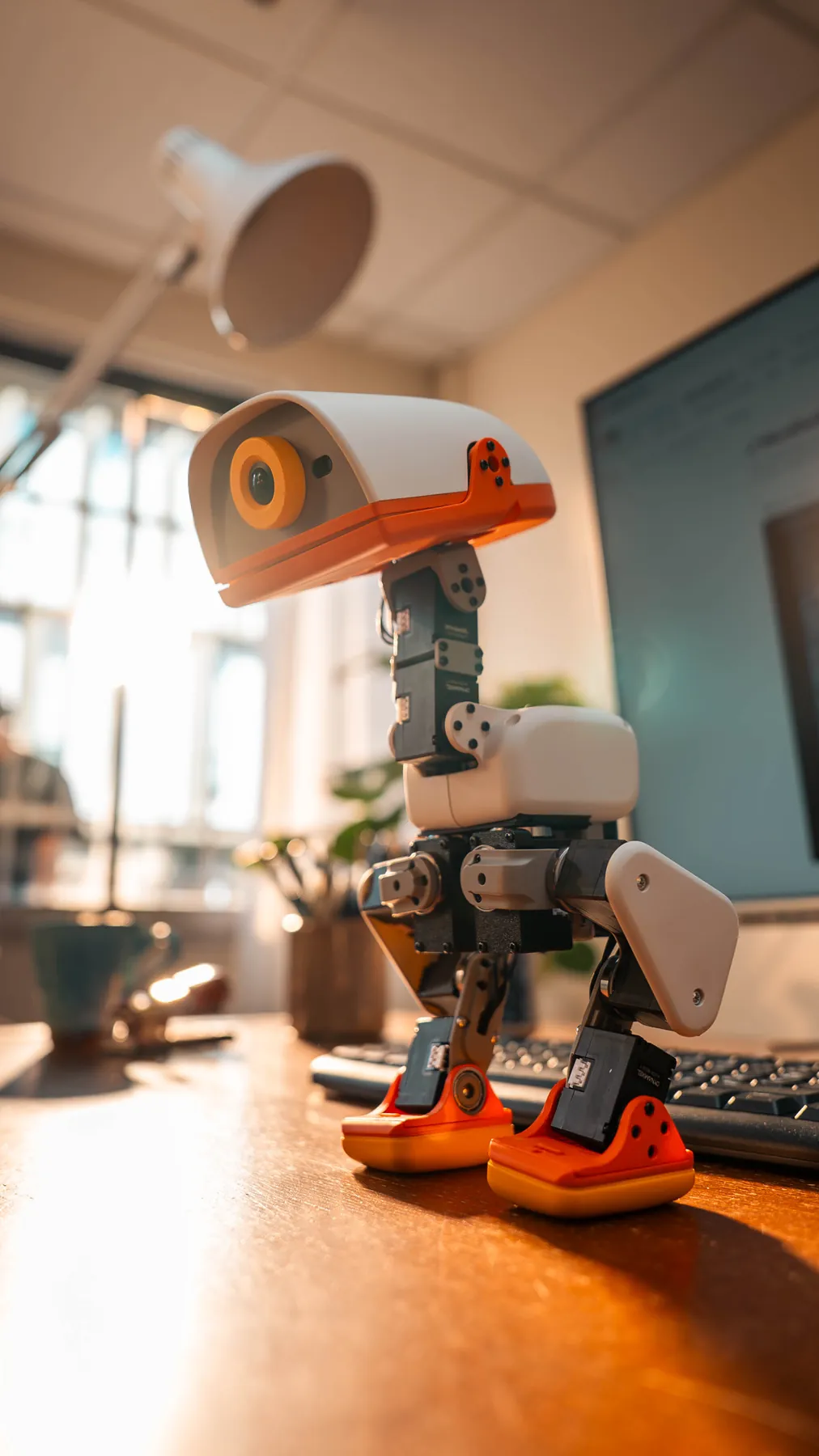
Specific body revision
Legally obtained files · structure · ordinary mechanics · final assembly
MechaSeed Agent Core · Concept · Demand Validation
Agent-ready by design, with target hardware and software matched to a specific Body Profile.
Starting with small bipeds · first Body Profile not yet selected
We are validating which printable body to support first. No Body Profile or hardware specification has been verified for production.
Body + Core
A Body Profile defines the boundary. MechaSeed would prepare the motion, electronics, sensing and software for one exact printable-body revision.
Legally obtained files · structure · ordinary mechanics · final assembly
Actuators · board · compute · sensors · wiring · power · software
Assembly checks first · agent experiments next
Why not just buy the parts?
Target comparison. A parts-only build may use capable components, but you remain responsible for making them work together for a specific body.
Body Profiles
Choose a supported printable body. We provide the matched hardware profile. That is the intended model; today, the first profile is still being selected. No Body Profile is verified as supported.
Select a researched printable body and exact revision.
Use the hardware and configuration mapped to that revision.
Assemble the actuators, wiring, compute and sensors.
Check zero positions and directions before programming.
Interest signal only · support not verified
Interest signal only · support not verified
Interest signal only · support not verified
Future asset
A profile records the assumptions that make configuration repeatable. It is a planned product layer, not a downloadable library or working CLI today.
Body name, revision and printable geometry
Models, mounts, IDs, bus and joint directions
Harness, pinout, sensors and power path
Reference offsets plus assembly checks
Joint model and target MuJoCo configuration
Firmware, state and proposed SDK surface
Assembly still matters. Factory actuator settings and reference offsets reduce setup work; every finished robot still needs zero-position and direction checks. Change the body geometry, link lengths, joint directions or actuator model, and the original profile must be reassessed.
Target integration scope
One concept product for community-built small bipeds. Categories below are feasibility targets, not finalized specifications or items available to order.
Matched smart actuators with target IDs and bus settings
Control board, actuator bus and profile-matched wiring
ARM-based compute for state, firmware and agent integration
Camera, IMU, distance sensing, microphone and speaker
Power management and battery interface targets
Full target contents, user responsibilities and exclusions are explained on the Agent Core page.
Join the Founding WaitlistAgent Ready
AI / Agent → MechaSeed SDK → Agent Core → matched actuators → your profile-matched printed robot.
Proposed API
Vision, audio, distance, motion and robot state are planned as one software surface.
Proposed API — final SDK may change.robot.see()
robot.hear()
robot.speak("Hello")
robot.move()
robot.look_at(target)
robot.distance()
robot.state()Demand Validation
The waitlist decides whether a Body Profile earns feasibility work. Only Stage 1 is current.
Current
Planned
Planned
Planned
Planned
Planned
Stage 1 — Current
Join with your email. The optional next step asks which body MechaSeed should evaluate first, plus format, budget, timing and reservation intent.
Clear answers
No. The target model is a set of versioned Body Profiles. Each profile would match a specific body revision, actuator layout, wiring plan and configuration. A modified or unsupported body would need a new fit and calibration assessment.
No. MechaSeed would prepare actuator and reference configuration for a Body Profile, but every finished assembly still needs zero-position and direction checks. Print tolerances, installation and structural changes can require recalibration.
The target combines matched actuators, control electronics, compute, sensing, power, a Body Profile, firmware and SDK examples. The final specification may change after feasibility work.
No body is verified as supported yet. MicroDuck is one research candidate and remains a third-party reference in our guide. Waitlist feedback helps decide what to evaluate first.
No. MechaSeed is at Stage 1 — Validate Demand. The waitlist and optional survey record interest; they are not an order, reservation or payment.